Mitsurugi
A Strategic Deep Dive into the Blade
Lore Archive
"Mirror, jewel, and sword — the three regalia — rest at the shrine, and of the swords only Ame no Murakumo is counted among them, drawn from the tail of the eight-headed serpent and renamed Kusanagi by the young prince who later carried it. Two more blades are kept beside it, gods in their own right: Ame no Habakiri, which felled that serpent in the first place, and Futsu no Mitama, whose descent alone laid the hostile gods of the mountains low. The Mikoto do not carry these blades into battle. They lay themselves upon the altar as offerings, and every life given calls the next serpent-blade back from the heavens."
The Mitsurugi are named after the sacred swords of Japanese myth: each Mikoto carries one, and its serpent Ritual Monster shares its colours. Follow a marked name to walk the trail.
Named after Kusanagi no Tsurugi, Susanoo's sword, and drawn in Mitsurugi Prayers. It shares its colours with Ame no Murakumo, whose ATK and DEF are twice its own.
Kusanagi's first name, and one of the three Imperial Regalia. Its body is Yamata no Orochi, in whose tail Susanoo found the sword (later carried by Prince Ousu, Wousu), and Kusanagi's blade stands behind it. Illustrations of it fill Ritual and Mirror.
Saji-Futsu-no-Kami, another name for the sword of the thunder god Takemikazuchi.
Takemikazuchi's sword, drawn in Mitsurugi Great Purification, with the highest DEF of any Reptile: twice Saji's ATK and DEF, in its colours, with its sword behind.
Worochi-no-Aramasa, a name for the sword Susanoo killed the Orochi with: Ame no Habakiri.
That sword itself, damaged when it struck the tail where Ame no Murakumo lay hidden.
The newest, from Alliance Insight: Prince Ousu, later known as Yamato Takeru, who went on to carry Kusanagi.
An illustration of Ame no Murakumo no Mitsurugi, and the first card that can Tribute monsters from the Deck.
A mirror bearing an illustration of Ame no Murakumo.
An illustration of Mitsurugi no Mikoto, Kusanagi.
An illustration of Futsu no Mitama no Mitsurugi.
Its shimenawa rope and paper shide make the snake statue a yorishiro, a vessel for a god.
The Cutting Edge
The "Mitsurugi" archetype, which debuted in the TCG in 2025 and has since been only partly imported to the OCG, represents a significant paradigm shift in modern game design, revitalizing both the Ritual Summoning mechanic and the long-underrepresented Reptile monster type, whose serpentine forms are wielded as divine blades. Its core identity is that of a highly resilient, resource-looping midrange strategy that thrives on generating advantage through a unique tribute-based engine. This lack of inherent restriction not only defines its internal playstyle but also enables its components to be integrated into other strategies as a potent and flexible engine.
Anatomy of the Blade: Core Engine
The strategic efficacy of the Mitsurugi archetype is rooted in the synergistic functions of its core cards. Each monster, spell, and trap is designed not merely to perform a single function but to act as a piece of a divine serpent blade, where costs are converted into advantages and resources are perpetually recycled.
The Divine Serpent Blades (The Payoffs)
Missing: 19899073
Ame no Murakumo
Primary boss, board-breaker, and control piece.
Missing: 13332685
Ame no Habakiri
Premier starter and critical extender.
Missing: 55397172
Futsu no Mitama
Lockdown and grind-game specialist.
The Mikoto Vassals (The Enablers)
Missing: 40543231
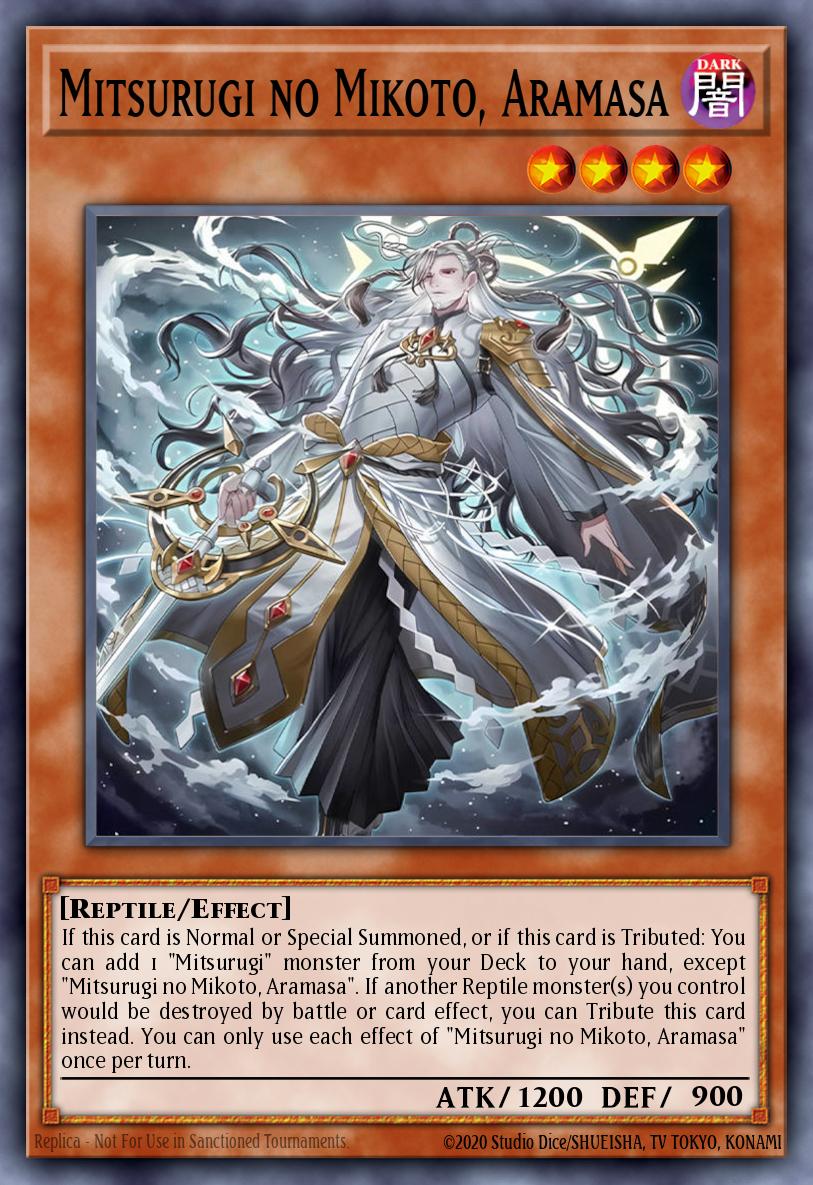
Aramasa
Primary monster searcher.
Missing: 18176525
Saji
Spell/Trap searcher counterpart.
Missing: 82782870
Kusanagi
Drives the long-term grind game and recursion.
The Sacred Spells (The Conduits)
Missing: 81560239
Mitsurugi Ritual
Heart of the archetype; Ritual Summons from Deck or hand.
Missing: 45171524
Mitsurugi Prayers
Versatile Quick-Play for searching and extending combos.
Missing: 49721684
Mitsurugi Mirror
Secondary Ritual Spell for grind game recursion.
Missing: 76725398
Mitsurugi Magatama
Flexible removal or an additional Ritual Summon.
The Divine Traps (The Interruption)
Missing: 17954937
Mitsurugi Great Purification
Searchable omni-negate that fuels the Tribute Loop.
Forging the Blade: One-Card Combo
The deck's consistency is exemplified by its ability to generate a multi-interruption endboard from a single Pre-Preparation of Rites. Explore the full list of Mitsurugi cards for more details.
Step 1: The Search
Activate Pre-Preparation of Rites, adding Ame no Habakiri no Mitsurugi and Mitsurugi Mirror from the Deck to hand.
Step 2: The Vassal Chain
Activate Habakiri's effect in hand. Reveal it to Special Summon Mitsurugi no Mikoto, Aramasa from the Deck, then Tribute Aramasa. The tributed Aramasa activates, adding Mitsurugi no Mikoto, Saji to hand.
Step 3: The Ritual From Deck
Normal Summon Saji. Its effect activates, adding Mitsurugi Ritual. Activate Mitsurugi Ritual, tributing the Level 8 Habakiri from your hand to Ritual Summon Ame no Murakumo no Mitsurugi directly from the Deck.
Step 4: The Tribute Loop
The tributed Habakiri activates, searching for Mitsurugi Prayers. It cannot revive itself here: it was Tributed straight from the hand, so it was never properly Ritual Summoned, and it stays in the Graveyard as fodder for Mitsurugi Mirror and Mitsurugi Great Purification. Activate Prayers, tributing Murakumo to search and extend. Murakumo then triggers, adding Mitsurugi Great Purification and reviving itself, which it can do because it was properly Ritual Summoned from the Deck.
Forging the Endboard: The Serpent's Coil
From a single incantation, the full might of the serpent blades is assembled, creating a coil of interruptions designed to systematically dismantle the opponent's strategy.
Note: This endboard previously included Abyss Dweller, which is now Forbidden. It has been updated with a common replacement.
Missing: 19899073
Ame no Murakumo no Mitsurugi
The centerpiece serpent blade. Murakumo serves as a persistent soft-negate, forcing your opponent to discard a card to resolve an effect. This constantly depletes their resources while staying on the field to fuel the Tribute Loop.

I:P Masquerena
Provides reactive disruption by allowing you to Link Summon on your opponent's turn. This can turn your board into a powerful non-targeting removal tool like S:P Little Knight, banishing a key threat at a critical moment.

Number 41: Bagooska
A potent floodgate. While in Defense Position, it forces all face-up monsters into Defense Position and negates their activated effects. This can completely halt monster-heavy strategies, buying you crucial time to assemble an OTK.
Missing: 17954937
Mitsurugi Great Purification
The searchable omni-negate. When set, this trap is the linchpin of the Tribute Loop. You can tribute Murakumo to negate any card, and Murakumo's own effect will then trigger, searching another card and immediately returning the serpent blade to the field.
Competitive Analysis
Strengths
- Resilience: The Tribute Loop creates a self-sustaining engine that can play through single interruptions.
- High Consistency: Multiple one-card starters and a dense network of searchers ensure combos are almost always accessible.
- Flexibility: The lack of in-archetype locks allows for powerful hybrid builds and access to generic boss monsters.
Weaknesses
- Key Chokepoints: An Ash Blossom on "Mitsurugi Ritual" summoning from Deck can be turn-ending without extenders.
- Systemic Counters: Highly vulnerable to "Droll & Lock Bird" which stops the search chains, and "Dimension Shifter" which breaks the GY loops.
- Graveyard Hate: Cards like "D.D. Crow" can banish a Ritual Monster in response to its trigger, breaking the Tribute Loop.
Synergies & Hybrids
- Ogdoadic: "Snake Rain" provides an incredible setup, loading the GY with both Ogdoadic and Mitsurugi targets for explosive plays.
- Ryzeal: A formerly popular variant that used the now-banned "King of the Feral Imps" for another consistent starter.
- Generic Reptile: Works well with lockdown strategies from Reptilianne or Aliens due to the shared monster type.
Replay Tools & Imported Lines
Analyze Mitsurugi replay paths, submit corrected routes, or step through the replay-backed combo line now attached to this page.
This imported combo is credited to Jimbo and rendered in the shared replay viewer below.
Habakiri Tachyon Ascent
Beginner Guide Available
A 1-card Ame no Habakiri line that loops Mitsurugi Ritual names into a Tachyon pivot, ending on Number 97: Draglubion access, Number 1: Infection Buzzking pressure, and a Numeron Dragon finisher while still leveraging the Mitsurugi tribute engine for follow-up.
✨ Replay by Jimbo March 2, 2026


Banlist Impact
LOW IMPACT: The Mitsurugi archetype has been moderately restricted by the TCG banlist, with Ame no Habakiri no Mitsurugi limited.
Archetype Cards
Limited
- • Ame no Habakiri no Mitsurugi
Banlist Status Summary
Core cards checked:
• Ame no Habakiri no Mitsurugi
• Ame no Murakumo no Mitsurugi
• Futsu no Mitama no Mitsurugi
• Mitsurugi Great Purification
• Mitsurugi Magatama
• Mitsurugi Mirror
• Mitsurugi Prayers
• Mitsurugi Ritual
• Mitsurugi Sacred Boundary
• Mitsurugi Tempest
• Mitsurugi no Miko, Wousu
• Mitsurugi no Mikoto, Aramasa
• Mitsurugi no Mikoto, Kusanagi
• Mitsurugi no Mikoto, Saji
+ Related cards checked:
• Clown Crew Biancaviso
• Clown Crew Diabolo
• Clown Crew Dristy
• Clown Crew Fiends
• Clown Crew Flair
• Clown Crew Malabarisme
• Clown Crew Matinee Operatics
• Clown Crew New Face
• Clown Crew Rehearsal
• Divine Golden Shadow Dragon Dragluxion
• Galaxy-Eyes Tachyon Primal
• Geonator Transverser
• Ghost Belle & Haunted Mansion
• I:P Masquerena
• Night Sword Serpent
• Number 100: Numeron Dragon
• Number 107: Galaxy-Eyes Tachyon Dragon
• Number 1: Infection Buzzking
• Number 41: Bagooska the Terribly Tired Tapir
• Number 97: Draglubion
• Number C107: Neo Galaxy-Eyes Tachyon Dragon
• Pre-Preparation of Rites
• Seventh Tachyon
• Tachyon Cloudragon analyzed •
1 total restriction found
• 1 archetype card